Scanner

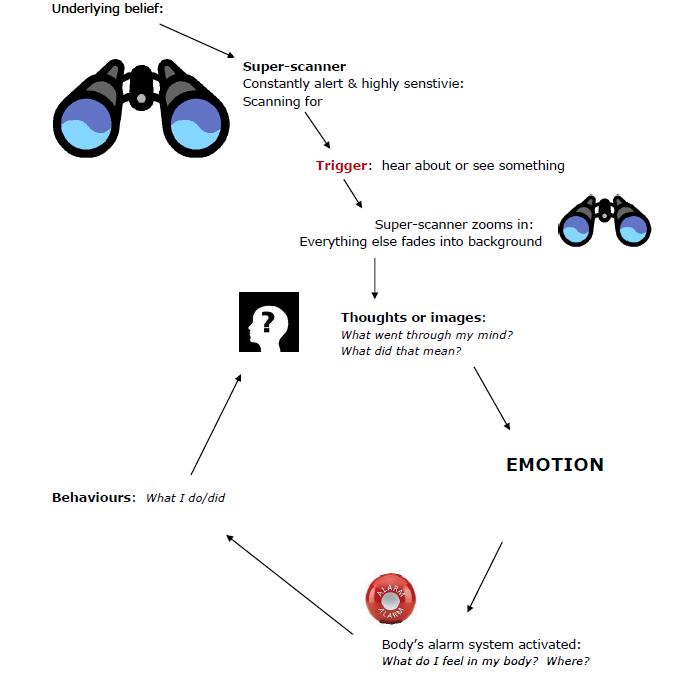
We have our own inbuilt super-scanners which are programmed to look for other signals, and it seems the sensitivity can vary.
For example, some people can sleep through anything - partners snoring, trains speeding by and thunderstorms. Yet those same people, after they've just had a baby, can be woken by the slightest sniffle. It seems we have an inbuilt scanner, that keeps us alert to certain signals, even when we're sleeping. It's constantly scanning for the signal, then triggering the body's alarm system which wakes us up, even from the deepest sleep, to attend to the baby.

Someone who worries about being burgled might have a super-scanner which is set to be highly sensitive to noises that are different from those we normally hear at night. A knocking sound will have them instantly awake, alert and anxious. On investigation, they might realise it was a twig tapping against the window, the anxiety subsides - and they can sleep reassured they're safe.
Our own super-scanners may be very personal to us, to our style of thinking, to our problem. Someone who is feeling depressed is likely to notice only the negative or bad things that happen, or interpret ordinary or positive events in a negative way. Their negative or gloomy super-scanner working overtime so that they only notice the negative or bad stuff.
Someone who gets anxious in social situations, might have a super-scanner that is constantly trying to read situations and people. Looking for a look, a tone of voice, something someone says or does. Trying to interpret what others are thinking, or 'really' thinking (critically of us) in spite of what they say. This mind-reading super-scanner is so highly sensitive that it creates meaning where there is none, or gives a very inaccurate meaning. We cannot know what others think.

If we're worried about our health, then the super-scanner might be constantly on, scanning for body sensations, which we might then interpret as meaning we're seriously ill.
If we suffer from panic attacks, then the super-scanner is going to be alert for those physical sensations (e.g. racing heart beat) which we believe indicates we're in immediate mortal danger!
If we've experienced a trauma in the past, then maybe our super-scanner would be scanning for any reminders of that trauma - something we see, hear, smell - anything that reminds us. The scanner then then triggers a distressing flashback.
Someone with low self-esteem might have a super-scanner that works continuously to find situations or triggers which cause us to think critically about ourselves.
Maybe your super-scanner is continuously scanning for something else. Understanding what your own personal super-scanner is doing, will help you understand what is keeping your problem going now.
Once your super-scanner is triggered, your focus of attention is right there. Your scanner and your thoughts react to the scanner, zoom into the foreground of your attention, and everything else fades into the background.

We can learn to notice the highly-sensitive super-scanner, and turn the sensitivity dial down. It can be a useful mechanism so we don't want to turn it off completely, but we can improve our ability to interpret the readings accurately, and adjust the way we react to the scanner.
- Notice the scanner: "That's that super-scanner again!"
- Readjust the sensitivity dial: "Okay, the scanner is noticing that ???, and that is triggering these unhelpful thoughts."
- There's no need to fight the thoughts, you can notice them, and let them pass.
- Change your focus of attention:
- Move on - do and/or think about something else.
How the Super-Scanner works
Useful Links
The Super Scanner PDF document version of this webpage
The Super Scanner: Health Anxiety PDF
Learn effective skills online
The Decider Skills for Self Help online course


BOOKS WE LOVE