Mindfulness
What is Mindfulness?
Jon Kabat-Zinn
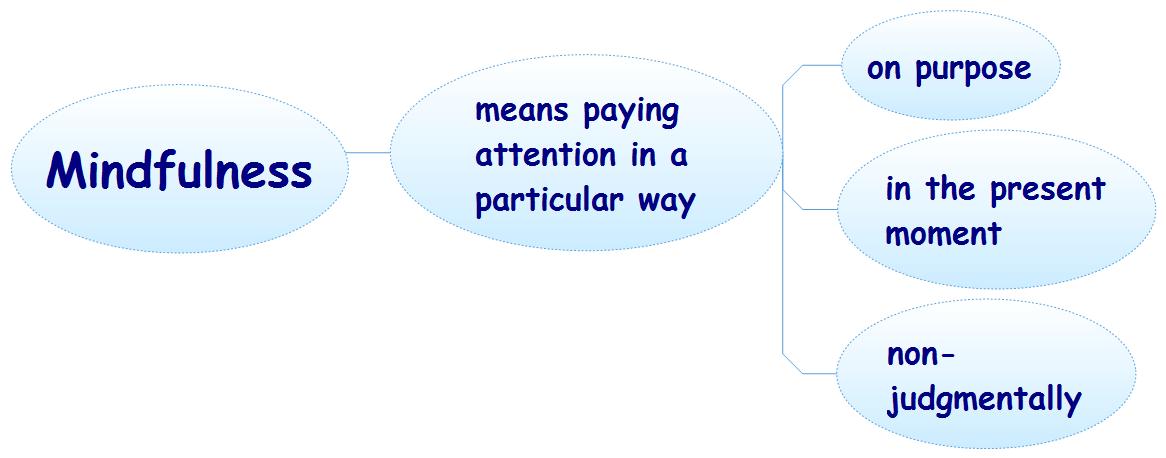
Mindfulness is an ancient Buddhist practice which is very relevant for life today. Mindfulness is a very simple concept. Mindfulness means paying attention in a particular way: on purpose, in the present moment, and non-judgementally. This increases awareness, clarity and acceptance of our present-moment reality.

Mindfulness does not conflict with any beliefs or tradition, religious, cultural or scientific. It is simply a practical way to notice thoughts, physical sensations, sights, sounds, smells - anything we might not normally notice. The actual skills might be simple, but because it is so different to how our minds normally behave, it takes a lot of practice.
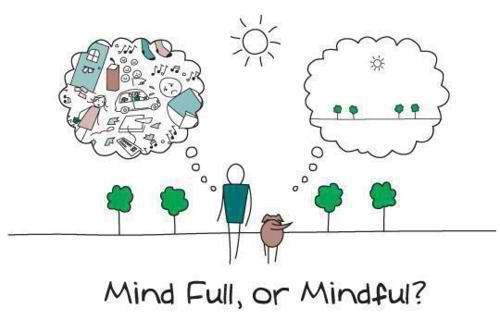
Animals and young children are very good at being mindful, in this present moment. I might go out into the garden and as I look around, I think "that grass really needs cutting, and that vegetable patch looks very untidy". Children on the other hand, will notice the ants or other crawlies.
Mindfulness can simply be noticing what we don't normally notice, because our heads are too busy in the future or in the past - thinking about what we need to do, or going over what we have done.
Being mindful helps us to train our attention. Our minds wander about 50% of the time, but every time we practise being mindful, we are exercising our attention "muscle" and becoming mentally fitter. We can take more control over our focus of attention, and choose what we focus on...rather than passively allowing our attention to be dominated by that which distresses us and takes us away from the present moment.
Mindfulness might simply be described as choosing and learning to control our focus of attention, and being open, curious and flexible.
Bill Murray describes mindfulness as being "alert and available".
Automatic Pilot
In a car, we can sometimes drive for miles on automatic pilot, without really being aware of what we are doing. In the same way, we may not be really present, moment-by-moment, for much of our lives: We can often be miles away without knowing it.
On automatic pilot, we are more likely to have our `buttons pressed`: Events around us and thoughts, feelings and sensations in the mind (of which we may be only dimly aware) can trigger old habits of thinking that are often unhelpful and may lead to worsening mood.
By becoming more aware of our thoughts, feelings, and body sensations, from moment to moment, we give ourselves the possibility of greater freedom and choice; we do not have to go into the same old `mental ruts` that may have caused problems in the past.
We can't be "mindful" all the time. Dogs and young children are naturally much better at it than we are! Research tells us that our minds wander at least 50% of the time. It's ok for minds to wander, but it is helpful to be able to notice e.g. when the mind wanders onto things that aren't so helpful, and then to choose our focus, even for a short time.
Mindful Activity
When I washed the dishes each evening, I tended to be "in my head" as I was doing it, thinking about what I had to do, what I did earlier in the day, worrying about future events, or regretful thoughts about the past. I heard my young daughter say "Listen to those bubbles Mummy. They're fun!" She reminded me often to be more mindful. Washing up has become a routine (practice of) mindful activity for me. I notice the temperature of the water and how it feels on my skin, the texture of the bubbles on my skin, and yes, I can hear the bubbles as they softly pop continually. The sounds of the water as I take out and put dishes into the water. The smoothness of the plates, and the texture of the sponge. Just noticing what I might not normally notice.
A mindful walk brings new pleasures. Walking is something most of us do at some time during the day. We can practice, even if only for a couple of minutes at a time, mindful walking. Rather than be "in our heads", we can look around and notice what we see, hear, sense. We might notice the sensations in our own body just through the act of walking. Noticing the sensations and movement of our feet, legs, arms, head and body as we take each step. Noticing our breathing. Thoughts will continuously intrude, but we can just notice them, and then bring our attention back to our walking.
The more we practice, perhaps the more, initially at least, we will notice those thoughts intruding, and that's ok. The only aim of mindful activity is to continually bring our attention back to the activity, noticing those sensations, from outside and within us.
Nature As Therapy Link
NOW: Mindfulness For Busy People - video
APPLE: A Mindful Response To Thoughts - video
Further Links
NOW - Mindfulness for busy people
APPLE: A mindful response to thoughts and feelings
Mindfulness leaflet - PDF
 MINDFUL BREATHING mp3
Female voice, with music.
22 mins.
 2.50
2.50 
MINDFUL BREATHING mp3
Male voice, with music.
15 mins.2.50
 MOUNTAIN MEDITATION mp3
Female voice, with music.
12 mins 20s
2.50
MOUNTAIN MEDITATION mp3
Male voice, with music.
16 mins.2.50
Self help Books Using Mindfulness
Mindfulness: A practical guide to finding peace in a frantic world
The Mindfulness and Acceptance Workbook for Depression
The Mindful Way through Anxiety: Break Free from Chronic Worry and Reclaim Your Life
The Mindfulness and Acceptance Workbook for Anxiety: A Guide to Breaking Free From Anxiety, Phobias, and Worry
Wherever You Go, There You Are: Mindfulness meditation for everyday life
Full Catastrophe Living, Revised Edition: How to cope with stress, pain and illness using mindfulness meditation
Peace Is Every Step: The Path of Mindfulness in Everyday Life


Useful links
NOW - Mindfulness for busy people
APPLE: A mindful response to thoughts and feelings
Mindfulness leaflet - PDF
MINDFUL BREATHING mp3
Female voice, with music.
22 mins.
2.50
MINDFUL BREATHING mp3
Male voice, with music.
15 mins.2.50
MOUNTAIN MEDITATION mp3
Female voice, with music.
12 mins 20s
2.50
MOUNTAIN MEDITATION mp3
Male voice, with music.
16 mins.2.50
Books
Mindfulness: A practical guide to finding peace in a frantic world
The Mindfulness and Acceptance Workbook for Depression
The Mindful Way through Anxiety: Break Free from Chronic Worry and Reclaim Your Life
The Mindfulness and Acceptance Workbook for Anxiety: A Guide to Breaking Free From Anxiety, Phobias, and Worry
Wherever You Go, There You Are: Mindfulness meditation for everyday life
Full Catastrophe Living, Revised Edition: How to cope with stress, pain and illness using mindfulness meditation
Peace Is Every Step: The Path of Mindfulness in Everyday Life
BOOKS WE LOVE