Esteem: Self Help For Low Self Esteem
We tend to go through life evaluating ourselves and others according to a scale of worth. The concept of self esteem is the amount of value that we consider we are worth. These values vary from person to person.
Whilst we might rate ourselves as being of little value, others might rate us much higher. If we get into the habit of thinking negatively about ourselves or comparing ourselves against others, then low self esteem, or placing little value on ourselves, is the result.
 Low self esteem can be a result of negative life experiences, particularly when we're young and most vulnerable. These experiences may include being criticised or judged negatively, such as from a parent or school bullies. As adults, abusive relationships and very stressful life events can also cause low self esteem. See Different Perspectives to learn how past experiences can affect our lives today.
Low self esteem can stay low, because of our own self-critical thoughts, which can be triggered by criticism, or perceived criticism (even if none is intended, we believe we are being criticised).
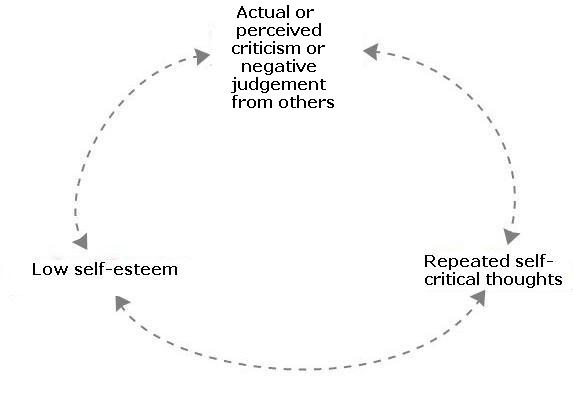
Self Esteem Quick Reference Sheet PDF
HOW LOW SELF ESTEEM AFFECTS US
Emotions

-
Negative, self-critical: I'm so stupid, I'm worthless, It's my fault, I'm a failure, I'm not good enough, I'm incompetent.
-
Unhelpful Thinking Habits might include Mental Filter, Mind Reading, Self Blame, Internal Critic, Compare & Despair, Shoulds and Musts, Black and White Thinking
Behaviours
-
get defensive when we believe we're being criticised
-
under-achieve or work harder to compensate and cover up our incompetence
-
neglect or abuse ourselves
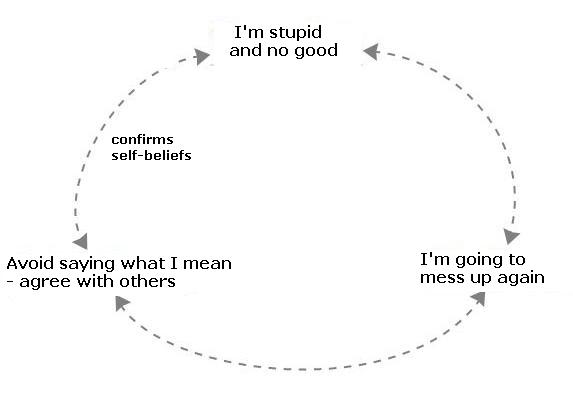
An example of how this can keep our self-esteem low:
Imagine you're given a parrot. This parrot is just a parrot - it doesn't have any knowledge, wisdom or insight. It’s bird-brained after all. It recites things ‘parrot fashion’ - without any understanding or comprehension. It’s a parrot.
However, this particular parrot is a poisoned and poisonous parrot. It's been specifically trained to be unhelpful to you, continuously commenting on you and your life, in a way that constantly puts you down, criticising you. For example, the bus gets stuck in a traffic jam, and you arrive at work 5 minutes late. The parrot sits there saying: "There you go again. Late. You just can’t manage to get there on time can you. So stupid. If you’d left the house and got the earlier bus you’d have arrived with loads of time to spare and the boss would be happy. But you? No way. Just can’t do it. Useless. Waste of space. Absolutely pathetic!"
How long would you put up with this abuse before throwing a towel over the cage, or getting rid of the parrot? We can often put up with the thoughts from this internal bully for far too long.
We can learn to use the antidote: notice that ‘parrot’ - and cover the cage. "There's that parrot again - I don't have to listen to it", and go and do something else. Put your focus of attention elsewhere. Be persistent in your practice! Eventually this poisoned parrot will tire of the towel, tire of you not responding. You'll notice it less and less. It might just give up its poison as your antidote overcomes it, or perhaps fly off to wherever poisoned parrots go.
(Vivyan 2009 - adapted from 'The Malevolent Parrot" by Kristina Ivings).
SELF HELP FOR LOW SELF ESTEEM
Identify the factors that help keep the problem going
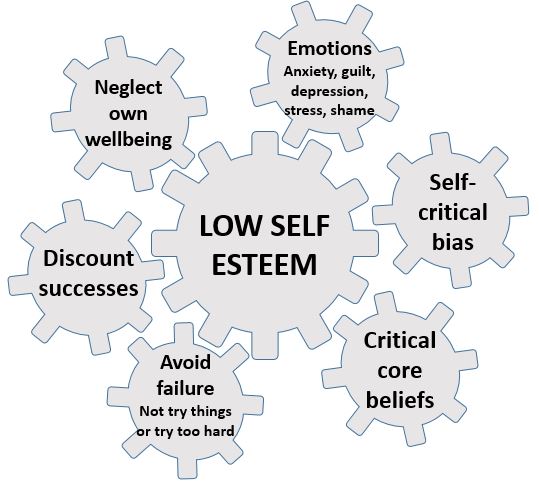
Use the cogs diagram (PDF) to help you identify what contributes to your low self esteem. Look at each factor and try to make changes in each.
Example vicious cogs of low self esteem:
MAKING CHANGES
Doing Things Differently
-
Set achievable and realistic goals. When you achieve them, congratulate and treat yourself, and allow others to congratulate you
-
Accept compliments - say thank you, and smile
-
Act the person you want to be - play the role for long enough and you can become that person
-
Look after yourself - eat healthily, exercise, do more things you enjoy doing
-
Stand, walk and talk confidently
- Nature As Therapy
-
Change your image - hair, clothes, make-up
-
Learn Mindfulness including NOW: mindfulness for busy people
-
Take up a new hobby or interest
-
Learn a new skill
-
Reward yourself for achievements and successes - however small
-
Thank others - show your appreciation, and others will appreciate you
-
Do things for others - help someone out. It makes us feel better about ourselves. Set limits and agree what you will and won't do.
-
If you can do something well, let others notice - when they notice your work, so their opinion of you will be raised, which in turn, raises your own self esteem
Thinking Differently
- STOPP! Pause, take a breath
- Ask yourself:
-
What am I reacting to? What have I been thinking about here?
-
Is this thought: fact or opinion?
-
Is that "Internal Critic" operating again?
-
There's that parrot again! I don't have to listen to it.
-
Am I getting things out of proportion?
-
How important is this really? How important will it be in 6 months time?
-
Am I expecting something from myself that is unrealistic?
-
What's the worst (and best) that could happen? What's most likely to happen?
-
Am I using that negative filter? Those gloomy specs? Is there another way of looking at it?
-
What would I think about someone else in this situation? What would I say to a friend?
-
Am I spending time ruminating about the past or worrying about the future? What could I do right now that would help me feel better?
-
Am I putting more pressure on myself, setting up expectations of myself that are almost impossible? What would be more realistic?
-
Am I jumping to conclusions about what this person meant? Am I mis-reading between the lines? Is it possible that they didn't mean that?
-
What do I want or need from this person or situation? What do they want or need from me? Is there a compromise? How could I act in a way that was more effective or helpful?
-
Am I just focusing on the worst possible thing that could happen? What would be more realistic?
-
Am I focusing on the negative, putting myself down? What wou
 ld be more realistic?
 -
Is there another way of looking at this?
-
Am I exaggerating the good aspects of others, and putting myself down? Or am I exaggerating the negative and minimising the positives? How would someone else see it? What’s the bigger picture or the Helicopter view?
-
Things aren’t either totally white or totally black - there are shades of grey. Where is this on the spectrum?
-
This is just a reminder of the past. That was then, and this is now. Even though this memory makes me feel upset, it’s not actually happening again right now.
-
What would be the consequences of doing what I normally do?
-
Is there another way of dealing with this? What would be the most helpful and effective action to take? (for me, for the situation, for the other person)
-
Use this Thought Record Sheet - Self Esteem
-
Be compassionate with yourself - just as you might be with someone else
-
What would a caring friend say to me in this situation?
-
What is a kind and constructive way to think about how I can improve this situation?
-
Whoever said human beings are supposed to be perfect?
-
Would a caring mother say this to her child is she wanted the child to grow and develop?
-
How will I learn if it's not okay to make mistakes?
-
-
Acknowledge your strengths - start by writing out a list of things you're good at, or what others have or do say about you.
-
Build a compassionate image
-
Notice the positives - carry a notepad around, and write down whenever you notice something good or helpful that you've said, or done, or what others have said about you
-
At the end of each day, ask yourself: What have I done or tried today that I've never done or tried before? What have I done to help other people today? Who has helped me? What have I enjoyed doing today?
Related Links
Self Help For Low Self Esteem - this page as PDF
Self Esteem Quick Reference Sheet

CONFIDENT & COMPETENT mp3
(for low self-esteem and self-critical thoughts)
Female voice, with music.
36 mins 30s 2.50
2.50 
CONFIDENT & COMPETENT mp3
(for low self-esteem and self-critical thoughts)
Male voice, with music.
39 mins2.50


Self Help Books
Overcoming Low Self-Esteem Self-help Course - 3 parts
Overcoming Low Self-Esteem
Overcoming Low Self-Esteem: Talks With Your Therapist (audio)
An Introduction to Improving Your Self-Esteem
Overcoming Low Self-Esteem with Mindfulness
Beat Low Self-Esteem With CBT: Teach Yourself
How to Deal with Low Self-Esteem: A 5-step, CBT-based plan
Boost Your Confidence: Improving Self-Esteem Step-By-Step
Self Compassion
Self-Compassion - I Don't Have To Feel Better Than Others To Feel Good About Myself


Mindfulness and Cultivate The Courage To Be You

The Mindful Path to Self-Compassion: Freeing Yourself from Destructive Thoughts and Emotions

BOOKS WE LOVE