Cognitive Behaviour Therapy
About CBT
CBT helps an individual make sense of their current problems, whilst understanding the influences of past experiences, using a diagrammatic representation or "formulation" which directs the treatment. This formulation may be highly individualised and more complex for severe problems, but may also include more simple vicious cycles when looking at what is helping to keep the problem going today.
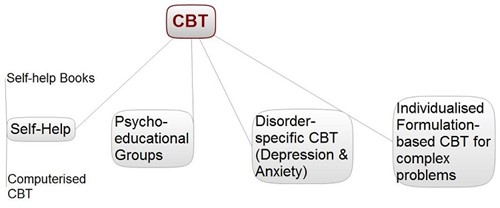
Therapy can be adapted according to the nature, severity and complexity of the problem. Mild-moderate depression and anxiety disorders for instance, can be effectively treated by self-help books or computerised CBT (cCBT).
Others may benefit more from face-to-face therapy, perhaps in a group setting, or by a relatively short course of weekly individual therapy sessions (perhaps 6-16 sessions). More complex and severe problems will require longer-term individualised formulation-based psychotherapy.
CBT has been shown in hundreds of studies (see links below) to be effective for many conditions, including depression, anxiety disorders (including generalised anxiety disorder, post-traumatic stress disorder, obsessive-compulsive disorder, social anxiety, panic disorder with/without agoraphobia, phobias), eating disorders, bipolar disorder, and many others.
The following includes external website links and PDF documents which will open in a new window.
The Evidence for CBT in any condition2021
Cognitive Behavioural Therapy: What's the Evidence?BABCP
NICE / NHS - Current
CBT Outcome Studies - references updated 2016
Why Cognitive Behavioural Therapy Is The Gold Standard 2018
CBT: Current Status 2015
Cognitive Behavior Therapy: Outcome Studies 2006
The Empirical Status Of CBT: a meta-analysis 2005
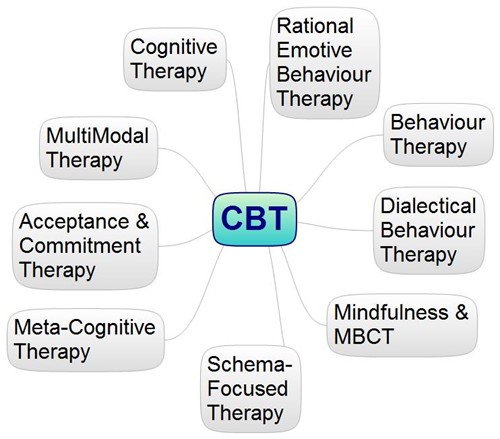
Current CBT practice originated in the 50s and 60s with Ellis (Rational Emotive Behaviour Therapy), Lazarus (MultiModal Therapy) and Beck (Cognitive Therapy), but they build upon the earlier work of the Behaviourist movement. The basic idea of Cognitive Therapy is perhaps not so new...Epictetus, a stoic philosopher and ex-roman slave in the first century said, in the Enrichidion: "Men are disturbed not by things, but by the view which they take of them".
Since those early pioneers in the 60s, standard CBT has evolved somewhat, and other approaches have arisen and developed, sometimes initially for particular client groups. CBT can now include a variety of therapeutic approaches, any of which can be incorporated into a course of therapy, or used as stand-alone therapies:
-
MMT: MultiModal Therapy
-
ACT: Acceptance & Commitment Therapy
-
DBT: Dialectical Behaviour Therapy
- Compassion Focused Therapy
Learn effective skills online (external link) - The Decider Skills for Self Help online course


BOOKS WE LOVE