ACT: Acceptance & Commitment Therapy
An introduction to ACT: Acceptance and Commitment Therapy. What is ACT? How is it relevant to my life?
ACT differs from CBT in that instead of challenging distressing thoughts by looking for evidence and coming up with a more rational response (CBT), in ACT, the thought is accepted as a thought, e.g. "I'm having the thought that this boat is going to sink", and then defused using a variety of techniques, which may include mindfulness, metaphors and language.
ACT uses three broad categories of techniques: mindfulness, including being present in the moment and defusion techniques; acceptance; and commitment to values-based living.
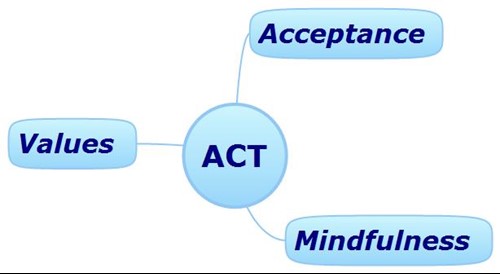
Mindfulness
Mindfulness is a way of observing our experience, in the present moment, without judgement. Mindfulness helps us 'defuse' - to distance ourselves from unhelpful thoughts, reactions and sensations.

"You can't stop the waves, but you can learn to surf"
Kabat-Zinn 2004
Acceptance
ACT is based on the idea that, generally, trying to rid ourselves of pain and distress only increases it, and turns it into something traumatic. The alternative is to accept it - but that doesn't mean giving up, being defeated or agreeing with suffering. Acceptance is an acknowledgement of and a willingness to allow these experiences.
We learn to make room for painful feelings, thoughts, and sensations - allowing them to be there, coming and going without us struggling against them.
Commitment and Values-based Living
You can learn to free yourself from the traps and barriers of life, and see what you really want your life to be.

A value is a life direction, an internal compass which guides us throughout life. Values are different to goals which have an end-point. Values are often life-long. Perhaps what we would like to be remembered for, or written as our epitaph, our headstone inscription.
Values give life meaning and purpose.
To identify our values, we can think about what it is in life that is REALLY important to us, the most important, what gives our life meaning and purpose.
Is it our relationships, e.g. to be a good parent? Is it our careers, connecting with nature, healthy living, community service or making a difference? Consider what legacy you want to pass on.
Having identified our values, we know where we want to go in life, the direction we want to progress towards. We might set goals along the way.
Knowing our values will help us decide how to react to stress and distress. In spite of how we feel, we can still move in the direction and service of our values.
The Quicksand
Suppose you come across someone standing in the middle of a pool of quicksand - there are no ropes or tree branches available. The only way you can help is by talking to them. The person shouts "HELP! GET ME OUT!", and is beginning to do what people do - struggling to get out. 99.9% of the time, the effective action to take is to walk, run, step, hop, or jump out of trouble.
Not with quicksand. Normally, to step out of something, you need to lift one foot and move the other forward. With quicksand, that's a bad idea. Once one foot is lifted, all the person's weight rests on only the other foot (half the previous surface area), and the downward pressure doubles. The person sinks deeper.
As you watch, you see them starting to sink deeper. If you understand how quicksand works, you might shout at them to lie flat, spread-eagled, to maximise contact with the surface. The person therefore probably won't sink, and might be able to roll to safety.
Since the person is trying to get out of the quicksand, it goes against all their natural instincts to maximise body contact with it. Someone struggling to get out of the mud, may never realise that the wise and safer action is to get with the mud.
Our own lives can be very much like this. The normal problem-solving methods that we use (sometimes repeatedly for years) to try to deal with the struggles we face, may themselves be part of the problem, just like someone trying to get free of the quicksand.
ACT offers something very different, to help us free ourselves from the quicksand we find ourselves in, but to get with it. By doing so, we can relieve our suffering and become empowered to lead valued, meaningful, dignified human lives.
Steven C Hayes (2005). 'Get Out of Your Mind and into Your Life '. New Harbinger. Oakland
Learn effective skills online
The Decider Skills For Self Help online course
Self Help Books
Get Out Of Your Mind And Into Your Life

The Mindfulness And Acceptance Workbook For Anxiety: A Guide to Breaking Free From Anxiety, Phobias, and Worry

Acceptance And Commitment Therapy For Dummies


ACTivate Your Life: Using acceptance and mindfulness to build a life that is rich, fulfilling and fun


Act Made Simple: An Easy-to-Read Primer on Acceptance and Commitment Therapy (New Harbinger Made Simple)

Acceptance and Commitment Therapy: The Process and Practice of Mindful Change

A CBT Practitioner's Guide to ACT: How to Bridge the Gap Between Cognitive Behavioural Therapy and Acceptance and Commitment Therapy

BOOKS WE LOVE